

Jeppesen Onboard Performance Tool (J‑OPT): Designing a Unified, Cross‑Fleet Performance Solution
Airlines operating mixed fleets often rely on multiple OEM‑specific applications—or homegrown tools—to run critical takeoff and landing performance calculations. These fragmented workflows create inefficiencies, training burdens, and operational risk. As a exploratory concept, Jeppesen set out to build a single, flexible performance application capable of supporting any aircraft type, regardless of manufacturer.
I joined the J‑OPT team as the Lead UX Designer, responsible for shaping the product vision, establishing UX processes, and guiding the design of a conceptual unified performance experience for pilots, dispatchers, and performance engineers.
*Note: Proprietary details have been removed or obfuscated. All content reflects my own experience and does not represent Boeing’s official views.*
My Role
As Lead UX, I drove the end‑to‑end design process, including:
-
Reviewing and synthesizing prior research and early concept work
-
Conducting dozens of user research and usability testing sessions
-
Creating initial concepts, paper sketches, and low‑fidelity workflows
-
Collaborating with the visual designer to develop mid‑fidelity wireframes and final UI direction
-
Partnering with the Business Analyst to translate insights into actionable requirements
-
Building prototypes used by Sales and Customer teams at global Connect events
-
Educating project leadership on UX processes, value, and user‑centered decision‑making
This role required not only design leadership, but also organizational influence—helping a team new to UX understand how research and iterative design shape a successful product.
Understanding the Challenge
A Fragmented Performance Landscape
Airlines often operate fleets that include multiple aircraft types from different OEMs. Each OEM typically provides its own performance tool, resulting in:
-
Multiple applications for a single airline
-
Inconsistent workflows and training requirements
-
Limited flexibility for airline‑specific needs
-
Increased risk of error during time‑critical operations
J‑OPT concept aimed to solve this by creating one performance tool to rule them all—a unified, configurable application that could support any aircraft in an operator’s fleet.
Illuminating the Path Forward
When I joined the project, the project leadership team had limited exposure to UX. My first responsibility was to help establish a shared understanding of:
-
What UX is
-
How research informs design
-
Why user testing is essential
-
How iterative workflows reduce risk and improve outcomes
I reviewed all prior research and early concepts, then worked with the business to clarify their goals and constraints. This alignment phase was critical—it created the foundation for a collaborative, user‑centered design process.
Re‑Tooling the UI
Revisiting Research and Reframing the Problem
I began by mapping user needs across key personas—pilots, dispatchers, and performance engineers. We ranked their tasks by frequency and criticality, which helped us prioritize workflows and identify where flexibility was essential.
Concept Development
-
Paper sketches to explore workflows
-
Low‑fidelity wireframes to validate structure
-
Mid‑fidelity mockups in Sketch created with the visual designer
-
Early design specifications used to align with business and systems requirements
Prototyping for Real‑World Feedback
I built a clickable prototype that became a key asset for Jeppesen’s Sales and Customer teams. It was showcased at three global Connect events:
-
Dallas
-
Singapore
-
Dubai
These sessions provided invaluable early feedback from operators around the world.

Figure 1: Early Paper Wireframe

Figure 2: LoFi Layout Concept
User Feedback Early and Always
Establishing a Continuous Research Loop
I led the UX team through a structured research and testing program, beginning with in‑person sessions at American Airlines in July 2018. These sessions helped the team:
-
Understand real‑world workflows
-
Identify user mental models
-
Validate assumptions
-
Build empathy across roles
Scaling Research Globally
From November 2018 through January 2019, we developed a remote testing approach that allowed us to work with operators worldwide. This dramatically expanded our reach and enabled us to gather feedback from:
-
Pilots
-
Dispatchers
-
Performance engineers
Across more than a dozen sessions, we refined the design, validated key workflows, and strengthened confidence in the product direction.
(Image placeholder: Remote testing workflow or insights summary)
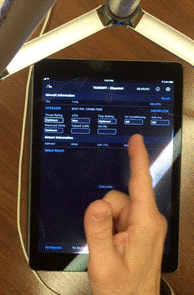
Figure 3: Usability Testing a High Fidelity Concept
Outcome
J-OPT was shelved due to the business decision to focus on improving existing applications and unifying the portfolio rather than adding an entirely new application to the family. However, the iterative research and design process resulted in:
-
A unified concept for an performance tool adaptable to any aircraft type
-
A flexible UI that supports diverse user roles and workflows
-
A validated design direction supported by global operator feedback
-
A prototype that became a cornerstone of Sales and Customer engagement
-
A more UX‑mature project team that embraced user‑centered design
J‑OPT’s design foundation provided my team with the opportunity to establish a solid reputation that would support us well in our future work on Boeing’s Onboard Performance Tool (OPT)
Reflection
This project represents a pivotal moment in my UX career—one where I combined domain expertise, research leadership, and organizational influence to guide a complex, safety‑critical product.
Through J‑OPT, I strengthened my ability to:
-
Lead UX strategy in ambiguous environments
-
Educate and influence stakeholders unfamiliar with UX
-
Conduct global research across diverse user groups
-
Translate complex operational workflows into intuitive interfaces
-
Build scalable design processes for long‑term product success
It remains one of the most impactful and rewarding projects I’ve led.